
Your Ultimate Hydrangea Guide
Posted by Jessie Jacobson on May 31st 2026
Your Ultimate Hydrangea Guide
Hydrangeas are a staple in any Zone 4 (but we're now officially Zone 5a!) garden. We love them and can't ever get enough. Their glorious blooms are the sweet reward at summer's peak. Hydrangea season is here, and since Minnetonka is the Hydrangea capital of the world (because we said so), you can never have too many! Here is what you need to know to choose and care for Hydrangeas.
Hydrangea arborescens - Smooth Hydrangea
Hydrangea arborescens are part to full shade, moderately-sized shrubs with large spherical flowers that bloom only on new wood. Prune smooth hydrangeas back in late winter or early spring to a height of one to two feet above ground to encourage abundant new growth. Fertilize two or three times per season between mid-May and mid-July with an acidic or bloom-focused fertilizer
Hydrangea arborescens varieties we love!
- 'Annabelle'
- 'Incrediball' ®
- Invincibelle® 'Garnetta®'
- Invincibelle® 'Mini Mauvette®'
- Seaside Serenade® 'Bar Harbor'
Hydrangea paniculata - Panicle Hydrangea
Hydrangea paniculata are part to full sun varieties with long-lasting, large, conical or lacecap panicles borne on new wood (the current season's growth). Prune panicle hydrangea by 30-50% in the late winter or early spring before they begin to leaf out. Fertilize two or three times per season between mid-May and mid-July with an acidic fertilizer such as Miracle Gro Miracid, or a bloom-focused fertilizer such as Espoma Flower Tone or Miracle Gro Bloom Booster.
Hydrangea paniculata varieties we love!
- 'Berry White'
- 'Bobo®'
- 'Diamond Rouge®'
- 'Early Evolution'
- 'Fire Light®'
- 'Fire Light Tidbit®'
- 'Limelight'
- 'Limelight Prime®'
- 'Little Hottie®'
- 'Little Lime®'
- 'Little Quick Fire®'
- 'Pinky Winky®'
- 'Quick Fire®'
- 'Strawberry Shake™'
Hydrangea macrophylla - Bigleaf Hydrangea
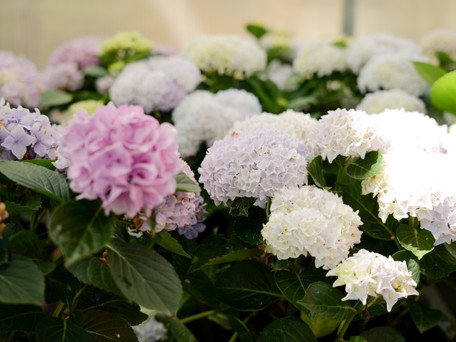
Hydrangea macrophylla are compact hydrangeas best suited for part-shade. Their colorful, spherical or lacecap blooms surprise and delight. Color-changing cultivars, including the Endless Summer® series, will express blue or pink blooms depending on soil pH. Garden amendments can further influence bloom color in these cultivars. Blooms turn bluer in color with the addition of a soil acidifier, and pinker in color with the addition of garden lime to increase soil alkalinity.
Modern bigleaf hydrangea cultivars flower on new and old growth, so pruning can be done anytime - alhough it is usually best performed in the spring. Extensive pruning beyond basic shaping and removing broken or damaged branches is not usually necessary. Fertilize two or three times per season between mid-May and mid-July with a bloom-focused fertilizer. Make sure to avoid nitrogen-heavy fertilizers.
Hydrangea macrophylla varieties we love!
- 'Blue Enchantress®'
- Endless Summer® 'BloomStruck®'
- Endless Summer® 'Eclipse®'
- Endless Summer® 'Pop Star®'
- Endless Summer® 'Summer Crush®'
- Seaside Serenade® 'Cape Lookout'
- Seaside Serenade® 'Cape May'
- Seaside Serenade® 'Hamptons'
- Seaside Serenade® 'Martha's Vineyard'
- Seaside Serenade® 'Crystal Cove'
Hydrangea petiolaris - Climbing Hydrangea
Hydrangea petiolaris are climbing hydrangea vines providing stunning blooms on an adaptable, woody, deciduous vine. Preferring full or part sun yet tolerating shade, climbing hydrangea are excellent for covering walls, fences, and large arbors - reaching a mature size of upwards of six feet wide and 30+ feet tall. A rugged vine for a variety of conditions, climbing hydrangea are also resistant to deer and rabbit feeding.
Hydrangea petiolaris varieties we love!
- Hydrangea petiolaris
- 'Miranda'
Hydrangea quercifolia - Oakleaf Hydrangea
Since the Twin Cities area is now classified as Zone 5a, Hydrangea quercifolia can now be planted and enjoyed in Minnesota gardens! Just like the name implies, Oakleaf Hydrangeas have oak leaf-shaped leaves that turn ruby red in the fall. Flowers are large, and cone shapped, but more pointed than panicle hydrangea flowers. Best planted in full sun to part shade, oakleaf hydrangeas should be offered extra winter protection just to make sure they survive the winter.
Hydrangea quercifolia varieties we love!
- First Editions 'Jetstream'
Planting
Spring, summer, and even into early fall are all suitable times to plant hydrangeas. Best practice is to avoid planting during the peak heat of the day, or during periods of drought. Most hydrangeas love part sun to part shade - with Panicle hydrangeas tolerating the most sun and Smooth Hydrangeas tolerating the most shade. Morning sun is ideal for most varieties, which provides a reprieve from the hot afternoon sun. Hydrangeas prefer well-draining soil rich in organic matter.
When planting:
- Dig a hole 2x the diameter of the pot
- Break up the root ball
- Plant so that the top of the root ball is even with the soil level, not above or below
- Backfill hole with 1/2 native soil and 1/2 rich soil like Purple Cow Activated Compost
- Water in thoroughly
- After planting, apply a thick layer of mulch using the 3-3-3 rule - 3 inches of mulch, 3 inches away from the base of the plant, 3 feet in diameter.
Watering
While named for the shape of their pods, the hydra in hydrangea means water. Make sure to water new plantings long and deep, about 1" of water per week to establish a vigorous root system. Water more frequently if you see signs of wilt or during periods of drought. Water in the morning before the heat of the day to allow water to soak - this helps avoid quick evaporation, allowing plants to dry through the day and hastening favorable disease conditions.
How to Change Flower Color, Endless Summer Types
In the case of the Endless Summer type Hydrangeas, the pH of your soil can influence the color of Hydrangea flowers. 5.0-5.5 (acidic soil) will turn your Hydrangea blooms blue while 6.0-6.5+ (neutral to alkaline soil) will turn your hydrangea blooms purple to pink. Add Espoma's Soil Acidifier for blue, and Espoma's Garden Lime for pink.
Prepare for Winter
Here in Minnesota, unpredictable winter weather extremes, snow totals, and freeze/thaw cycles swing wildly. Although many hydrangeas are considered hardy in our area, all of this can throw them for a loop. They do need a little extra attention in order to survive our harsh winters and come back bigger and better next year. Implement these steps to maximize your hydrangea potential:
Don't stop watering!
Take the pledge! Raise your right hand and say, “I will water my hydrangeas until the ground freezes solid.” Cool, drying winter winds suck the moisture right out of the plants – and hydrangeas don’t use lip balm. Doesn’t have to be hot to be dry!
Add Compost
Give your hydrangeas a boost for next season by adding compost to your beds in the fall. The same is true for hydrangeas. They’ll be hungry for some good compost after a long winter’s nap. After a good night’s sleep, everybody feels better with a good breakfast in their belly. Applied in the fall, compost can break down over winter - making nutrients readily available in spring.
Mulch
Mulching protects and insulates the crown and roots of your hydrangeas from extreme winter temperatures. If all goes as it should, snow acts as a natural insulator. However, weird winters with little snowfall and drastic temperature swings are detrimental to plants. To give hydrangeas their best chance at success, apply a layer of chunky mulch around the base of the plant. Decorative mulch is helpful, but we recommend straw, marsh hay, or fallen leaves.
After the ground has frozen and you've top-dressed with compost, apply a 6"-8" layer of mulch. This insulates plants and protects plants from the heave-ho of spring freeze/thaw cycles which in extreme cases can push them right out of the soil. Mulching too early invites rodents to make this their cozy winter dwelling - thus causing rotting and disease. This can also trick the plant into thinking it's time to wake up.
Wrap it Up
Wrap or completely cover marginally hardy hydrangeas. This is especially important for those that bloom on old wood, such as bigleaf hydrangeas (H. macrophylla). However, note that newer varieties of bigleaf hydrangeas bloom on both new and old wood. Good for them, good for us! Generally, hardier hydrangeas such as the H. paniculata and H. arborescens don't need extra winter protection. However, extreme cold can cause die-back of their branches. If a colder than normal winter is predicted, consider covering.
Loosely wrap plants with a couple layers of burlap, making sure to secure it with sturdy twine. Another option is to make a mulch mountain, covering the majority of the plant. The latter works best for newly-planted, smaller specimens.
Pruning
Pruning hydrangeas is important to overall plant health, appearance, and maintenance of their natural shape. Pruning also promotes fresh growth and encourages flowering. With regular pruning, the risk of disease and decline is greatly reduced as an open, healthy plant promotes good air flow.
Prune shrubs that bloom on new wood (buds are formed on new growth during the current growing season), in late winter or early spring. In the Twin Cities, this is late March or early April. You may also prune this type of shrub in the fall, but most gardeners like to leave dried blooms for winter interest. This includes panicle and smooth hydrangeas. Prune panicle (H. paniculata) hydrangeas in the late winter or early spring before they begin to leaf out, pruning back each stem by up to 30-50%. Prune smooth (H. arborescens) hydrangeas back to one to two feet above ground in late winter or early spring to encourage abundant new growth.
Modern bigleaf (H. macrophylla) hydrangea cultivars flower on new and old growth, so pruning can be done anytime - but is usually best performed in the spring. Extensive pruning beyond basic shaping and removing broken or damaged branches is not usually necessary.
If desired, prune climbing hydrangeas back after blooming.
Remove
- Dead, damaged, and diseased branches
- Unwanted branches (top 1/3, old blooms, duplicate/parallel, sprouts, rubbing branches)
- Overgrown smaller twigs and branches
- Thick old growth - trim to the ground when renovating or refreshing.
- Once established, it is okay to remove 30% - 50% of your shrub with each pruning.
Make Cuts
- At a 45-degree angle
- Just above a bud or set of leaves
- Just above a side branch
- At the node, where one branch or twig attaches to another, being careful not to cut into the branch collar which functions to close off the wound at the cut.
- All the way to the ground; a well-established shrub (one that is a few years old) will benefit from removing the oldest wood down to the ground, about 1/3 each year. This is called renewal pruning.
There you have it! Your ultimate guide to planting, growing, and caring for hydrangeas! Hooray for hydrangeas!
If you would like assistance with picking out or caring for hydrangeas, feel free to stop in and ask! Otherwise, email us at hello@tonkadale.com - we're here to help!