
Repotting Indoor Plants
Posted by Jessie Jacobson on Feb 2nd 2026
Repotting Indoor Plants
As the days get longer, we experience a welcome increase in sunlight. This signals our plants to wake up and start growing. Early Spring is a great time to think about re-potting indoor plants!
Check out our video Houseplant Spa Day: Soil Refresh for a visual & narrarated guide!
When to repot
- The soil is depleted of nutrients
- Plants will look pale in color and/or sickly
- The plant is root-bound: there are more roots than soil in the pot
- Roots are pushing out the bottom of the pot or encircling the stem
- The height of the plant is greater than 3x the height of the pot it is planted in:
- The plant is top heavy or is unstable
- Exceptions for floor plants and certain design aesthetics
- The plant is top heavy or is unstable
- Plant growth has slowed or ceased, and it is not due to winter dormancy.
- The soil has lost its water-holding capacity requiring more frequent watering:
- Water runs right out the drainage holes each time you water.
How to choose a container
- Bump Up! When repotting plants for the purpose of increasing the root zone, we recommend bumping your plant up one size. Grower pots are generally sized in even numbered inches: 4", 6", 8", 10 etc.
- Include Drainage! Always choose a pot with drainage. Grower or Nursery pots are a great place to start (4" Pot, 6" Pot). These can be easily be dropped into decorative containers that do not have drainage holes. Simply take your plant to the sink to water, let it drain, then return it to its decorative container.
- If you like to plant directly into decorative container, that's just fine. Terra cotta pots almost always have a drain hole and corresponding saucer. If the pot you purchase at Tonkadale doesn’t have a drainage hole, we are happy to drill one for you when you check out.
Check out our video on using grower pots/nursery planters as drop-in containers!
How to choose a potting soil
Potting soil is the foundation of plant success. A proper potting mix ensures that your plant has everything it needs including micro & macro nutrients, aeration (oxygen), and water retention. All-purpose potting soil will work great for most repotting projects, but consider choosing a specialty soil if you are growing orchids, violets, bonsai, cactus, or succulents. We recommend our house blend Tonka Terra Indoor Potting Soil for basic planting needs, and we love Sol Soils' Cactus Gritty Mix for our succulent and cactus friends!
Time to repot
When it's time to repot, it's nice to have a plan in place. Use a repotting mat, or a long and low storage bin to catch the mess. Don't be afraid to get in there and get a little rough, plants can handle it!
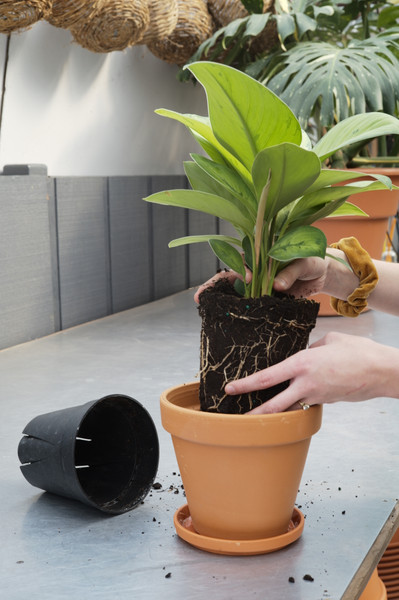
- Gently pull the plant out of the old pot. You can loosen the pot from the plant by squeezing or pressing on the pot.
- Break up the root ball to "wake up" the roots.
- Add a few inches of soil to new pot.
- Add in soil amendments! Check out this blog to read about Sol Soil's biotics.
- Place your plant in the new pot.
- Back-fill in soil around the plant, ensuring that all roots are covered.
- Lightly tamp down soil, and help it settle in between the roots by tapping the side of your pot.
- Water-in well, doing so until it drains out the bottom of the pot.
You did it!