
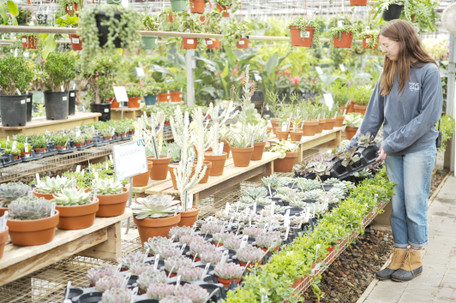
Our Most Common Houseplant Questions
Posted by Sara Berg on Jan 26th 2026
Our Most Common Houseplant Questions
Every season at Tonkadale, we hear the same plant questions pop up again and again: What plants are best for x condition? How often should I water this? Is this plant pet-safe? If you’ve ever wondered the same things, you’re in good company. In this blog, we’re answering the most common houseplant questions we hear - with straightforward and practical tips to help your plants flourish.
What's a Plant That...
is easy to propogate?
- Pothos, Tradescantia, Spider Plants, Peperomia, Philodendron:
- Snip off a small cutting, ensuring that there is at least one node (bump where roots form) on the stem. Place in water, and in a few weeks you should have roots! Be sure to change the water often to avoid algae & rot.
- Jade, Succulents, and Cacti:
- Carefully twist off leaves, or gather fallen ones from your pot. Let them dry for a few days to a week to callus over, and then place them on the top of some well-draining soil in a pot. Place in bright, indirect light, and only water the soil when it is completely dry.
doesn't mind overwatering?
- Carnivorous Plants: In nature, carnivorous plants grow in soggy, wet bogs. They want to be wet all the time, but be sure to use distilled or rainwater.
- Lucky Bamboo: Lucky Bamboo grows well in just water - also ideally distilled or rainwater. Be sure to change the water often to avioid algae & rot.
doesn't mind underwatering?
- Cacti, Ponytail & Sago Palm, ZZ & Snake Plants, Living Stones: these guys all tolerate drying out thanks to their ability to store water in their chunky stems, leaves, and trunks.
is okay with low light in a bathroom?
Ultimately, little to no light means these guys will be surviving, not thriving. Consider getting a small grow light to keep them happier, or maybe just some faux greenery instead.
is a unique plant to gift to a plant lover?
Unique plant options are endless! We love recommending quirky hoyas, trendy monstera varieties, or other collectors' plants like funky anthuriums or philodendrons.
stays colorful during the winter months?
African Violets, Orchids, Cyclamen, Anthurium, and Holiday Cacti all offer colorful blooms during the winter months.
Bromeliads, and Stromanthe offer colorful foliage that stays bright during winter months.
is a large floor plant, but is also safe for pets?
Neanthe Bella Palm, Palm Phoenix, Banana Plant, and Boston Ferns are all pet-safe, large plants.
If you're looking for a different option, be sure to check the ASPCA's website to confirm that it is pet-safe.
How Do I...
know when to fertilize?
It depends on what you are growing!
For indoor plants, we recommend fertilizing with an all-purpose fertilizer such as Schultz Plant Food at least twice per month during active growth – generally spring through fall. Use a plant-specific fertilizer for certain plants like Cactus, Orchids, African Violets, Citrus, and Palms. Cut back on fertilizer in the winter months when the sun is low in the sky and the days are short. Read more about Fertilizing Indoor Plants here!
know when to repot?
1) When the plant is root bound: where you can see that the roots are all wrapped into each other, and/or sticking out of the bottom of your pot.
2) The soil doesn't hold water, or is just one hard mass: when you water your plant the water may just spill off the soil, or run right through the pot rather than soaking into the soil.
3) Your plant is losing pallor and vigor: the leaves look a little sickly or off-color from what they usually are.
If you would like to repot your plant but it isn't experiencing any of those symptoms, don't forget to ensure that your pot has a drainage hole and is no more than 1-2 sizes larger than its grower pot.
If the pot you purchase at Tonkadale doesn’t have a drainage hole, we are happy to drill one for you when you check out. For more information, read our Guide to Repotting Indoor Plants!
know when to water?
Consider the following:
- What does the plant want? Consider its natural environment. If it’s a fern or it came from a tropical region, it likely wants consistently moist soil (but not dripping and soggy). If it’s a high water plant check the soil often, a couple times per week minimum, for moisture content. If the soil is dry an inch down, water through, let drain. If it’s a cactus or succulent, let the soil dry completely between watering, a month may pass before these plants needs water again.
- How much light is the plant receiving? Sansevieria in a low light environment may only need to be watered once a month. However, Sansevieria in a bright light environment may need water more frequently.
- Is the plant actively growing or dormant? Check for watering needs more frequently in spring and summer, as this is when the plant is working hard to put on new growth. Ease up on watering in the fall and winter, as this is when the plant is essentially dormant and not taking up as much water.
- How big is the container? The amount of soil in the container in comparison to the size of the root ball is important. If the container is large, and the root ball only takes up about half the amount of the container, the soil will dry more slowly. If the container is small, or the root ball consumes most of the soil, it will dry more quickly.
- How humid is the environment the plant is in? Plants growing in the bathroom, kitchen, or near a humidifier will dry out much less quickly than plants that are not or are in close proximity to a heating vent. The exact same type of plant grown in two different locations may have drastically different watering needs.
If you have a planty question that was not answered here, feel free to stop in and ask! Otherwise, email us at hello@tonkadale.com - we're here to help!