
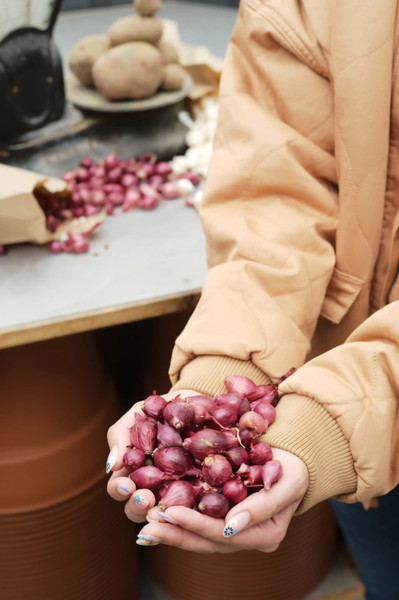
Planting Seed Potatoes and Onion Sets
Posted by Jessie Jacobson on Apr 19th 2026
How to Plant, Grow, and Harvest Seed Potatoes and Onion Sets
Seed potatoes and onion sets can be planted as soon as our spring soil is tillable. This is usually late April, or early May in the Twin Cities. Make sure the soil is at least 45°F, and that day time temperatures are consistently 50°F and above so we don't disturb our pollinator friends.
Onions and potatoes love full sun - at least six hours of sun per day. Both need to be planted in a rich, well draining soil with lots of organic matter. Garden beds or raised beds are both good options. It's a good idea to enrich your soil with compost to add much needed nutrition and organic matter to the soil. We recommend Purple Cow Activated Compost. One cubic foot bag covers 10 square feet of garden.
Make sure to rotate where crops are planted each season, and be careful not to plant potatoes in the same location as other Solanaceous crops like eggplant, peppers, or tomatoes. As members of the same plant family, these crops are susceptible to similar pest and disease problems, many of which overwinter in the soil and may emerge the following season.
When purchasing seed potatoes and onion sets, make sure they are in good condition: assure that they are definitely not squishy, moldy, or stinky. Store them in a cool, dry place until it's time to plant.
Seed Potatoes
Seed potatoes aren't really seeds at all; simply potato tubers cut into sections. At Tonkadale, seed potatoes are sold in 2lb bags.
Two pounds of seed potatoes will yield 10-15 "seeds". Plant them in rows, 12 inches apart. This should equate to about 10-15 row feet per 2lb bag of potatoes.
The following varieties are available at Tonkadale for the 2026 Season:
Norland Red: An early producing, medium-sized, oblong potato with white flesh and smooth, red skin. Good resistance to potato scab. Good for salads, frying, and roasting. Shop here!
Yukon Gold: An early to mid-season potato with thin, gold skin and yellow flesh with rich flavor. It's sweet, buttery flavor is perfect for boiling, baking, frying, mashing, and salads. Shop here!
Russet Burbank: Late season harvest, 110-135 days. The most widely grown potato in North America. This heirloom variety has been a favorite for over 100 years. Use for baking and frying. Good resistance to potato scab. 10 mini tubers or seeds will produce up to 40 lbs of full-sized potatos. Stores well, up to 5 months. Shop here!
Planting, Growing, and Harvesting Potatoes
Planting
- Cut potato tubers into 2-ounce pieces with a clean, sharp knife. Make sure there is at least one eye per piece - this is where a shoot is produced!
- Allow pieces to cure/dry (between 60-70°F) on newspaper overnight.
- Prepare a deep and loose soil bed by adding compost and tilling to a depth of 8 inches.
- Plant potato pieces 4 inches deep and 12 inches apart, with the eye(s) facing up. Cover with soil. Rows should be 36 inches apart.
Growing
- If danger of frost occurs, cover new foliage (if less than 5 inches tall)
- Mound soil around plants when above ground growth is ~12 inches tall. Leave 2 inches of green growth each time you mound.
- This aids in maximum tuber production, and prevents shallow tubers from light exposure - which causes them to turn green and produce a bitter, potentially harmful toxin called solanine.
- Potatoes need 1-2 inches of water per week for maximum yields. Low moisture levels can result in low yields or knobby, hollow tubers. Rain is sufficient if a good, deep soak occurs. Supplement by deeply watering at the base of each plant. Avoid splashing the foliage to prevent the opportunity for disease to develop.
- Fertilize at the onset of flowering. We recommend Espoma's Organic Garden Tone.
Harvesting
- Harvest by gently loosening the soil with a pitchfork, 7-8 weeks after planting for “new potatoes” - or when the foliage has yellowed, dried out, and fallen over for fully mature potatoes.
Onion Sets
Onions can be purchased in sets or as seedlings. Onion sets are small onion bulbs that were grown from seed the previous year. Onions are grouped by either short day or long day varieties. Long day varieties generally have larger bulbs that form when daylight lasts 14-16 hours.
At Tonkadale, onion sets are sold in 1lb bags which will yield about 15 row feet.
The following varieties are available at Tonkadale for the 2026 Season:
White: Large, white bulbs with a crisp, fine texture. Grow green onion tops or grow to bulb stage. Excellent for slicing and salsa. A long day onion.
Yellow: Produces heavy yields of sweet, flavorful onions that weigh up to 1lb. Adds sweetness and crunch to sandwiches and salsa. Great for sauté or cooking. Store up to 6 months. A long day onion well suited for Northern gardens.
Planting, Growing, and Harvesting Onions
Planting
- Plant onion sets pointy side up, 1-2 inches deep and 3-4 inches apart. Firm soil around the bulbs.
Growing
- Soak soil thoroughly when watering, to a depth of at least one inch each week during the growing season. Onions have shallow roots and require constant and even moisture for even growth.
- Insects are not normally a problem when growing onions, however onion maggots are a potential pest. Row covers are a good way to keep them out.
- Diseases that can infect onions include Fusarium basal rot, Botrytis neck rot, and bacterial soft spot. To avoid these problems, manage weeds and take care not to injure bulbs while working in the garden.
Harvesting
- Harvest onions when about half of the tops are falling over, turning yellow, and dry. Undercut and lift bulbs with a spading fork to loosen them from the soil.
- Once pulled, leave onions on the ground for several days if the weather is dry and warm, or cure indoors if not. This is essential if you plan to store your onions. Cut off foliage when properly dry.
- Store in a cool, dry place. Onions may sprout if stored over 40 degrees F.
You really haven't experienced life until you have pulled one of these little ding-dang darlings out of the ground. Just add butta!
If you would like to know more about seed potato and onion planting - feel free to stop in and ask. Otherwise, email us at hello@tonkadale.com - we're here to help!