
Carnivorous Plants 101
Posted by Caitlin Nelson on Mar 8th 2026
Carnivorous Plants 101
There are more than 600 species of carnivorous plants, making it one of the most diverse groups in the plant kingdom. Carnivorous plants can be found on every continent except Antarctica. There are even 14 species native to Minnesota, including the Purple Pitcher Plant. Carnivorous plants live in humid, wet, conditions, and need to stay wet to survive.
To check out the varieties we have available at this time, click here.
Top Tips for Planting & Growing
Helping carnivorous plants thrive starts with replicating their naturally nutrient-poor habitat as best as we can. A simple way to do this is to use a soil mix of 1 part peat to 1 part horticultural sand.
Click here to watch our video demonstration of building a bog-like terrarium!
Watering & Humidity
Water ONLY with distilled, reverse-osmosis, or rainwater - the minerals in tap and bottled water can harm the plants.
Keep soil at minimum damp, or wet at all times. This will also provide them with the humidity that they need - keeping a closed lid on your carnivorous plant can cause mildew or fungus growth.
When watering, be careful to not get water on the plants themselves. Water on flytraps may prematurely set them off, and water on butterworts or sundews may rinse the mucilage (sticky substance that attracts insects) off the leaves. To prevent this, you can bottom water or use a pot-in-your-pot to keep soil moist.
Light
Sunny conditions are best for carnivorous plants, and full sun will help bring out the best pigmentation. If in full sun, be extra mindful of the soil drying out.
Fertilizing
Do not fertilize your carnivorous plants - they will get the nutrition that they need from the insects that they trap. Do not supplement feedings with anything that is not a small insect. If they are not attracting insects in your home, supplementing with fruit flies or freeze-dried bloodworms are an option to help provide this sustenance.
To learn more about care for carnivorous plants and to download our care card, click here.
Venus Flytrap (Dionaea)
The most popular carnivorous plant sold in stores is the Venus flytrap. Venus flytrap's trap-closing movement is called thigmonasty, which is a plant's nondirectional response to being touched. Inside the trap are tiny hairs called trichomes that when touched, trigger the trap to close on its prey. The plant then uses digestive enzymes to decompose the bug over the course of a few days. Once the prey has been fully digested, the trap opens for its next meal.
While it seems fun, it’s important not to play with the traps because they each only open and close a finite number of times before they die off. Also, the oils on your fingers will disrupt the surface tension needed for the trap to function properly. Handle plants with clean, dry hands or tweezers.
Pitcher Plants
Pitcher plants use nectar in various ways to lure insects to their traps:
- Lubrication: Nectar produced on the outside and lip of the pitcher helps insects slip inside the trap.
- Nectar Trails: Nectar trails along the pitcher’s length attract crawling insects on the surface of the soil.
- Toxic Bait: Nectar from some pitcher plants contains a neurotoxin that makes insects temporarily clumsy and more likely to stumble into the pitcher.
- Amino Acids: Some insects seek out nectar with amino acids, which may increase the number of insects that visit and get caught.
- Specialized Scents: Pitcher plants may target their prey by using specialized scents. Some may smell more floral to attract bees, whereas others smell fruitier to attract fruit flies. Some utilize stinkier scents to lure in ants and flies.
North American Pitcher Plant (Sarracenia)
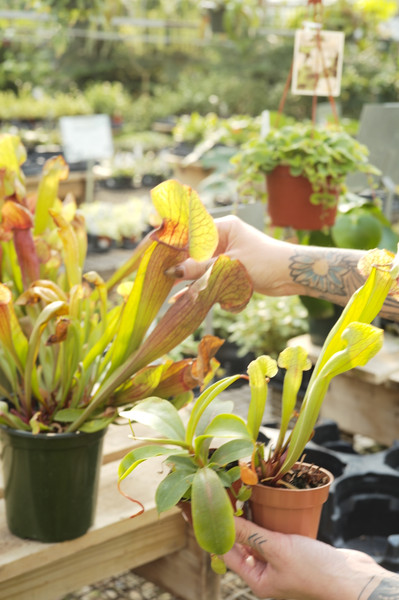
Sarracenia, the North American Pitcher Plant, has leaves shaped like bulbous tubes. These fill with rainwater and an acidic enzyme solution. Pitcher plants use nectar near the rim of their cups to attract foraging, flying, or crawling insects. The rim is slippery due to condensation and the nectar, causing the insects to fall into the pitcher plant.
The interior of the pitcher’s tube is full of tiny downward pointing hairs which help prevent the insect from crawling back up the wall of the pitcher. At the base of the pitcher, the enzyme solution digests the insects over the course of a few hours, soaking up all its nutrients.
Tropical Pitcher Plant (Nepenthes)
Nepenthes are another pitfall trap style carnivorous plant. These plants have modified leaves that form large pitchers at the ends of tendrils.
Lower ground pitchers are commonly colorful with striped or speckled patterns. Two wings, or ladders run along their front to encourage insects to climb up to the mouth. They commonly rest along the ground or dangle up to a few feet in the air.
Upper pitchers are smaller and less colorful than ground and primarily prey on flying insects.
Both upper and lower pitchers are filled with rainwater and nectar. The walls inside the pitchers are smooth and slippery, which makes it difficult for prey to climb out and escape. Digestive enzymes break down their prey while nutrients are absorbed.
There are multiple species of Tropical Pitcher Plants that are able to digest vertebrates including reptiles and small mammals. Some have evolved to catch more than just prey including nutrient-dense feces from animals such as bats, large rodents, and frogs.
Butterwort (Pinguicula)
Butterworts or Pings, are cute, little rosette shaped plants covered in tiny hairs and coated with a sticky nectar that attracts their prey. Small insects like fungus gnats land on the leaves, get stuck, and are unable to fly away. Trapped insects are slowly digested by the digestive enzymes on the surface of the leaves. There are both temperate and tropical Butterworts. During colder months tropical Butterworts go into dormancy, stop creating sticky nectar, and develop succulent-like leaves that are able to store nutrients and water for the dormancy period.
Sundew (Drosera)
The largest genus of carnivorous plants is Drosera, or Sundews. These are another example of a sticky trap plant. Sundews have long, thin leaves covered in hairs that secrete sweet nectar that is attractive to its prey. When an insect lands on the leaves it gets stuck. The hairs then roll around the prey, trapping it further. Digestion occurs over a course of a few days.
Visit us at Tonkadale to meet these quirky cuties in person!