
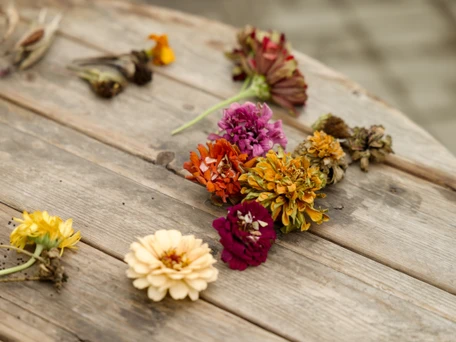
Seed Saving
Posted by Amaya Fairbanks on Sep 27th 2026
Seed Saving
Stages of Seed Saving
Choosing: deciding what plants you want to save is the best part! Some blooms that save well are Celosia, Nasturtium, Calendula, Marigolds, Sunflowers, Cleome, Cosmos, Snapdragons, Nigella, and California Poppies.
Harvesting: patience is key, being sure to let seeds mature on the stem but not waiting so long that birds & small animals or weather affect your harvest.
Drying: spread harvested seeds onto a single layer on wax paper or a screen for best ventilation. Leave in a dry, warm spot in controlled temps and out of direct sunlight. This may take one to four or more weeks, depending on the type of seeds. Seeds should be brittle and unable to be dented when pressed by your fingernail when dry.
Threshing: the loosening of seeds from their pods or husks. You can separate the two by rubbing them between your hands, stomping on them, or even pounding with a stick.
Winnowing: an ancient agricultural practice using air current to seperate mature seed from its husk or chaff (other debris/biomass). Seeds can be blown by breath or fan, tossed in a cloth, or poured from one container to another. Viable seed is heavier, and will fall to the bottom of your container. The chaff should be removed because it can harbor pathogens and be detrimental to the seed saving process.
Collection & Storing: once you're left with just seeds, they can be stored for future planting! Paper envelopes are best for breathability, but mesh bags work as well. It's important to assure that there is not moisture in your storage system, hence why breathable containers are best.
Labeling: don't forget to label! Be sure to label your envelope with the date of harvest (including the year), and details of the variety of plant that the seed is from. Seeds lose viability over time, so adding in the date helps keep track of this.
When to Harvest
One of the keys to properly saving seed is being able to identify mature or ripe seeds. Mature seeds are more viable than their under-ripe counterparts. Specimens from earlier in the season are often more pest-free and therefore create more viable seeds.
A pollinator must have pollinated a flower for its seed to be viable. So, a cut flower in a vase cannot produce seed for saving. Bees transfer pollen from flower to flower, cross-pollinating the flower population. This transfer between flowers is what creates new and exciting varieties. If you are hoping for true seed, you can isolate flowers with small mesh bags or distance them from other varieties in your garden.
A harvestable flower will have been pollinated and left on the stem to cure or age. It’s best to keep waiting until the flower and stem are a mature, dry, brown. Rain and frost can adversely affect this, so balancing the weather with proper maturation time can be a challenge.
Dahlias
We often continually harvest flowers in hopes of producing more dazzling blooms. To create viable seed, a bloom must be left on the stem, fully-bloomed with an open center so that it is more easily pollinated. This can make it hard to get blooms of doubles, ball, and pompon dahlias that have been pollinated by bees and matured to a ripe stage.
After the petals fall away, it will form a pod shape. It may take several weeks for the pod to fully dry out. Use the squeeze test - does it release liquid? Keep maturing the pod until it is dry. Each seed in a dahlia will create a new variety, different from every other seed in its pod. Each will have some characteristics of the parent plant, and some characteristics of whatever other dahlia pollen the bee was carrying at the time of pollination. This creates endless possibilities and completely unique varieties. You can grow Dahlias from tubers (always true to their parent plant, a perfect clone) or from seed (a surprise offspring with endless possibilities).
Open Pollination
Open-pollination occurs when pollen is transferred from one plant to another; usually by wind, water, or insects. Cross-pollination is the direct transfer of pollen from one plant to another of the same species.
Open-pollinated seeds are "true to type" or "true to seed," meaning that they should have the same characteristics as their parent plant when grown.
Open-pollinated plants are more genetically diverse because there are no restrictions on pollen flow. This allows plants to adapt to local growing conditions over time.
If you would like assistance in saving seeds, feel free to stop in and ask! Otherwise, email us at hello@tonkadale.com - we're here to help!