
Identifying Minnesota Bumblebees
Posted by Sara Berg on Aug 2nd 2026
Identifying Minnesota Bumblebees
Identification
The Complexities
The University of Minnesota Extension offers an amazing, easy-to-use identification guide for bumblebees in Minnesota which will be referenced below.
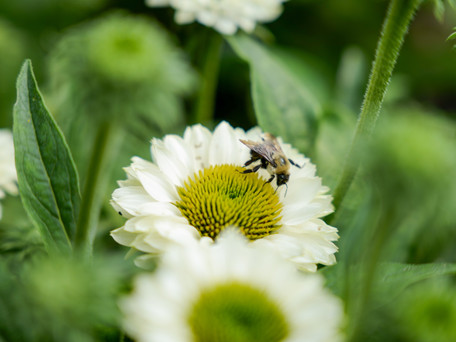
When identifying bumblebees, examining the different hair colors on their thorax and abdomen will help narrow your search down quickly. Take a look at the pictures below of a bumblebee perched on the "cone" of a pink coneflower. Such is the nature of bees, this one was a little too excited about its business for me to get a great head-on shot.
Thorax: We can see that it has an almost entirely yellow, fuzzy thorax with a black spot in the middle. It doesn't look like it's quite a perfect black circle, but it's clear that there is yellow hair around each side of the black spot. This helps us eliminate any potential bees that have a black stripe between their wings.
Abdomen: This bee appears to have seven sections to its abdomen. Seven sections indicates that this is a male bee. Segment A1 is solid yellow, A2 is yellow with a brown streak in the center, and A3-A7 are solid black. The presence of brown on its abdomen helps us eliminate quite a few bees.
The only bee species on our guide that has a black spot (not stripe) between the wings, and a brown spot surrounded by yellow at the top of its abdomen is Bombus affinis!
Rusty-Patched Bumblebee
The Rusty-patched bee Bombus affinis is Minnesota's offical state bee, which was designated in 2019 to help bring awareness to the bee's endangered status. Rusty-patched bees have been listed as endangered by the U.S. Fish and Wildlife Service for nearly a decade. While the exact cause is unknown, this is likely due to stressors like insecticide and fungicide exposure, habitat loss & degradation, and climate change.
Conservation work to help protect and monitor Rusty-Patched bees is ongoing - but you can help from the comfort of your home! Simply keeping an eye out for these bees and reporting any sightings (ideally with photographs) to Bumble Bee Watch and iNaturalist is a wonderful way to participate in citizen science and help contribute to local biodiversity data!
Further Reading
If you would like assistance identifying or supporting native bumblebees, feel free to stop in and ask. Otherwise, email us at hello@tonkadale.com - we're here to help!