
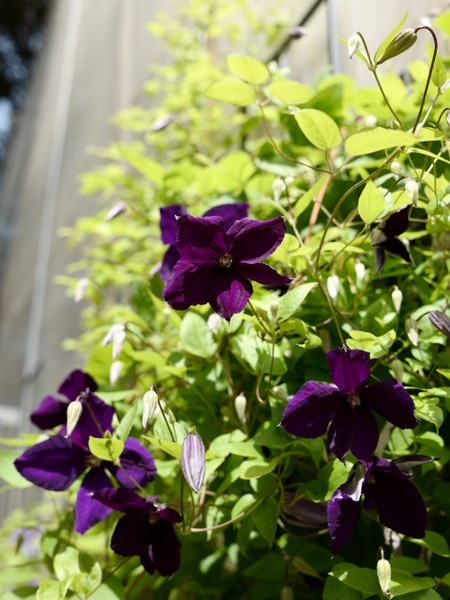
Clematis Care
Posted by Aaron Barton on Jun 14th 2026
Clematis Care
Belonging to the buttercup family Ranunculaceae, Clematis are unmatched in their versatility and beauty. They offer a variety of well over 300 species, including the North American native C. virginiana, as well as hundreds of cultivars to appeal to the casual gardener and avid collector alike.
Vining Clematis are categorized by bloom time to help simplify their care, excluding non-vining herbaceous Clematis such as the shrubby C. integrifolia, which dies back to its woody base each winter. While not necessarily required, yearly pruning will promote better blooming performance and healthier, more attractive plants.
Bloom Time Groups
Group 1: Early flowering, setting bud only on old wood (the previous season’s growth), and blooming in the spring on mature stems. Little pruning is required, and any pruning should be conducted immediately after flowering in mid-summer. Prune no later than the end of July to avoid interfering with bud set for next season.
Group 2: Early, large-flowered hybrids, blooming twice: first in late spring through early summer on old wood, and again in mid-summer to fall on new wood (the current season’s growth). Prune in late winter or early spring, completely removing any dead or weak stems and cutting back remaining stems by about a third down to just above a pair of strong, swollen buds. If desired, additional pruning should be conducted immediately after the first flush of late spring blooms to help encourage reblooming.
Group 3: Late flowering, blooming from mid-summer to fall on new wood. Includes the first modern large-flowered hybrid, Clematis ‘Jackmanii’ and the fall-blooming C. paniculata ‘Sweet Autumn,’ as well as C. viticella and C. texensis varieties. Prune in late winter or early spring one to two feet up from the base of the plant, leaving at least two bud pairs per stem.
Planting
- Clematis prefer moist, well-drained soils in full sun but will tolerate part sun, and are intolerant of high soil temperatures.
- Before planting, cut stems back to 12” tall above a pair of low buds with a sterile blade to minimize stem breakage, encourage branching, and promote the formation of additional shoots.
- Dig a hole twice as wide and slightly deeper than the root ball. New Clematis should be planted one to two inches deeper than they were grown in their container to help protect the plant crown.
- Mulch plants well to cool the root zone and provide additional winter protection, taking care to leave four to six inches of space around the stems to allow for adequate airflow.
- Position companion plantings to help keep Clematis roots shaded and cool while their blooms soak up the sun - think "warm faces and cool feet."
- Avoid disturbing the root zone or moving Clematis after planting, and allow new plantings a minimum of three years to establish and begin producing significant vine growth.
Care
- Support Clematis by planting about 12" from a trellis, tripod, or other stake/structure to allow their twining leaf petioles to climb.
- Carefully help plants to start twining around new supports.
- Fertilize one or two times per season in mid-spring and mid-summer with a bloom-focused fertilizer such as Espoma Flower Tone or a standard all-purpose fertilizer like Osmocote.
Clematis Wilt
Avoid stem breakage when tying up or handling plants to help prevent Clematis Wilt, a localized fungal disease introduced through wounds. Mostly affecting younger large-flowered hybrid Clematis, this fungus causes sudden stem collapse, often just before buds open, with stems and leaves then turning black and dying off above lesions within a few days. Careful handling and sanitation are the best means of prevention. Diseased stems should be cut to the ground with a sterile blade and thrown away immediately, not composted. Apply a fungicide to protect from further disease spread.
If you would like guidance on caring for or choosing the perfect clematis, feel free to stop in and ask! Otherwise, email us at hello@tonkadale.com - we're here to help!